
Notarization is an important part of many legal, financial, real estate, and personal transactions. Whether you need to sign a power of attorney, real estate document, affidavit, trust document, loan package, or business agreement, understanding the notarization process can help you feel prepared and confident before your appointment.
This guide explains the process for notarizing documents, what you should bring, how to prepare, and what to expect when meeting with a notary public.
What Is the Notarization Process?
The notarization process is a formal procedure used to help verify the identity of a document signer and reduce the risk of fraud. A notary public acts as an impartial witness during the signing of important documents.
While notarization does not prove that the contents of a document are true or legally valid, it does confirm key details about the signing process, such as:
- The signer appeared before the notary.
- The signer’s identity was verified.
- The signer signed willingly.
- The notarial act was completed according to applicable requirements.
Depending on the document, the notary may perform an acknowledgment, jurat, oath, affirmation, or another authorized notarial act.
Step 1: Review the Document Before Your Appointment
The first step in the process for notarizing documents is to review your paperwork carefully before meeting with the notary. Make sure the document is complete and ready for signing.
Before your appointment, check that:
- All pages are included.
- Blank spaces are filled in or properly marked.
- Names are spelled correctly.
- The document has the correct notarial wording, if required.
- You understand what you are signing.
A notary public cannot provide legal advice, draft documents, or explain the legal meaning of your paperwork. If you have questions about the document’s content, it is best to speak with an attorney, lender, escrow officer, or the party requesting the notarization before your appointment.
Step 2: Bring a Valid Form of Identification
Identity verification is one of the most important parts of the notarization process. The notary must confirm that you are the person named in the document.
You should bring a valid, government-issued photo ID. Common examples may include:
- Driver’s license
- State identification card
- U.S. passport
- Foreign passport, when acceptable
- Military identification, when acceptable
- Other approved government-issued identification
Your ID should generally be current, include your photograph, and contain identifying information that allows the notary to verify your identity. The name on your ID should reasonably match the name on the document being notarized.
Step 3: Meet With the Notary in Person
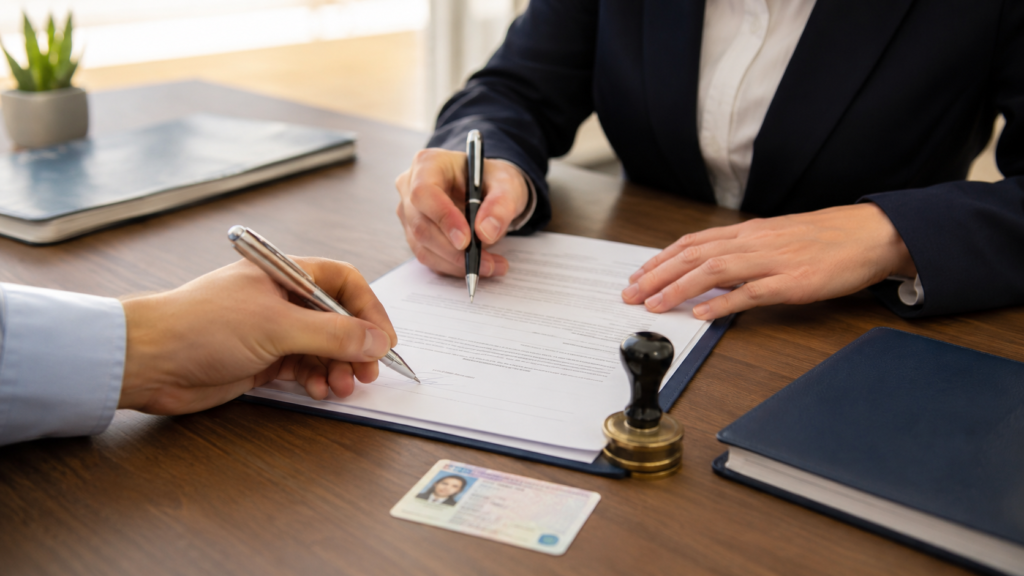
For most traditional notarizations, the signer must personally appear before the notary. This means you must be physically present during the appointment so the notary can verify your identity, assess your willingness to sign, and complete the notarial act.
During the appointment, the notary will typically:
- Review your identification.
- Confirm the type of notarial act needed.
- Make sure the document is complete.
- Watch you sign the document, if required.
- Complete the notarial certificate.
- Add the official notary seal or stamp.
- Record the notarization in the notary journal, when required.
This step helps protect all parties involved and supports the integrity of the notarized document.
Step 4: Sign the Document Correctly
One of the most common mistakes people make is signing too early. Some documents must be signed in front of the notary, especially when the notary is completing a jurat or witnessing the signature.
To avoid delays, do not sign your document before the appointment unless you have been specifically instructed that it is acceptable. If the document requires acknowledgment of a previous signature, the notary may be able to notarize it if you confirm that the signature is yours. However, requirements can vary depending on the document and notarial act.
When signing, use the name format shown on the document whenever possible. If your ID and the document use different versions of your name, let the notary know before signing.
Step 5: Complete the Notarial Certificate
After identity verification and signing requirements are satisfied, the notary completes the notarial certificate. This certificate is the section that confirms the notarial act was performed.
A notarial certificate may include:
- The date of notarization
- The location of the notarization
- The signer’s name
- The type of notarial act
- The notary’s signature
- The notary’s official seal or stamp
If the document does not include the correct notarial wording, you may need to contact the requesting party or legal professional to determine what type of certificate is required. A notary cannot choose the notarial act for you unless allowed under applicable rules.
What to Bring to a Notary Appointment
Being prepared can make the process for notarizing documents much faster and smoother. Before your appointment, gather everything you may need.
Bring the following:
- The complete document that needs notarization
- A valid photo ID
- Any required witnesses
- Any instructions from the requesting agency, lender, attorney, or escrow company
- Payment for notary services
- A quiet, appropriate signing location, especially for mobile notarization
If witnesses are required, confirm whether they must be provided by you or whether the notary can assist with arranging them. Witness rules may vary depending on the document type.

How to Prepare for the Notarization Process
A little preparation can help you avoid common delays. Before the notary arrives or before you visit a notary office, take a few minutes to confirm the details of your appointment.
Here are a few helpful preparation tips:
- Do not leave required fields blank unless instructed.
- Do not sign documents that must be signed in front of the notary.
- Make sure all signers are present and have valid ID.
- Confirm whether witnesses are needed.
- Ask the receiving party what type of notarization is required.
- Ensure the signer is alert, aware, and willing to sign.
- Schedule enough time for multi-page or complex documents.
If the document involves real estate, estate planning, medical authorization, or financial authority, preparation is especially important. These documents often require careful signing and may include multiple initials, signatures, or notarial certificates.
Common Documents That May Need Notarization
Many different types of documents may require notarization. Some of the most common include:
- Power of attorney documents
- Real estate deeds
- Loan documents
- Trust and estate documents
- Affidavits
- Consent forms
- Business agreements
- Vehicle title documents
- Travel consent letters for minors
- Medical authorization documents
The exact notarization process may vary depending on the type of document and the notarial act required.
Why Mobile Notary Services Make the Process Easier
Mobile notary services are a convenient option for busy professionals, families, seniors, hospital patients, real estate clients, and anyone who prefers notarization at a location of their choice. Instead of traveling to an office, a mobile notary comes to you.
Mobile notarization can be especially helpful when:
- Multiple signers are in different locations.
- A signer has limited mobility.
- Documents need to be notarized after regular business hours.
- Real estate or loan documents must be signed quickly.
- You need a notary at a home, office, hospital, care facility, hotel, or other convenient location.
By choosing a mobile notary, you can simplify the process for notarizing documents and complete your paperwork with less stress.
About VIP Notary Services in Santa Monica
At VIP Notary Services, we make the notarization process convenient, professional, and efficient. We are a California-certified traveling mobile notary service based in Santa Monica, proudly serving Santa Monica, West Los Angeles, and all surrounding neighborhoods.
Our mobile notary services are available 24/7 by appointment, giving clients the flexibility to schedule notarization at a time and location that works best for them. Whether you need documents notarized at your home, office, hospital, care facility, hotel, or another convenient location, VIP Notary Services is here to help make the process simple and stress-free.

Contact VIP Notary Services Today
Understanding the process for notarizing documents can help you arrive prepared, avoid delays, and complete your notarization with confidence. From reviewing your document and bringing proper identification to signing in front of the notary and completing the notarial certificate, each step plays an important role in protecting the integrity of your paperwork.
If you need dependable mobile notary services in Santa Monica, West Los Angeles, or a surrounding neighborhood, contact VIP Notary Services today. Schedule your 24/7 mobile notary appointment and let us come to you.
FAQs
The process for notarizing documents typically begins with reviewing the document, verifying the signer’s valid photo ID, confirming the signer is acting willingly, and completing the required signature or oath. After that, the notary fills out the notarial certificate and may record the notarization in a notary journal.
A standard notarization can often be completed quickly when the document is ready, the signer has proper identification, and all required parties are present. More complex appointments, multiple documents, or missing information can make the process take longer.
In many cases, you should not sign your document before meeting with the notary because the notary may need to witness your signature. Some notarizations allow you to acknowledge a signature already made, but it is best to ask before signing.
Yes, every person whose signature needs to be notarized must personally appear before the notary. The notary must verify each signer’s identity and confirm that each person is signing willingly and knowingly.